

Glass
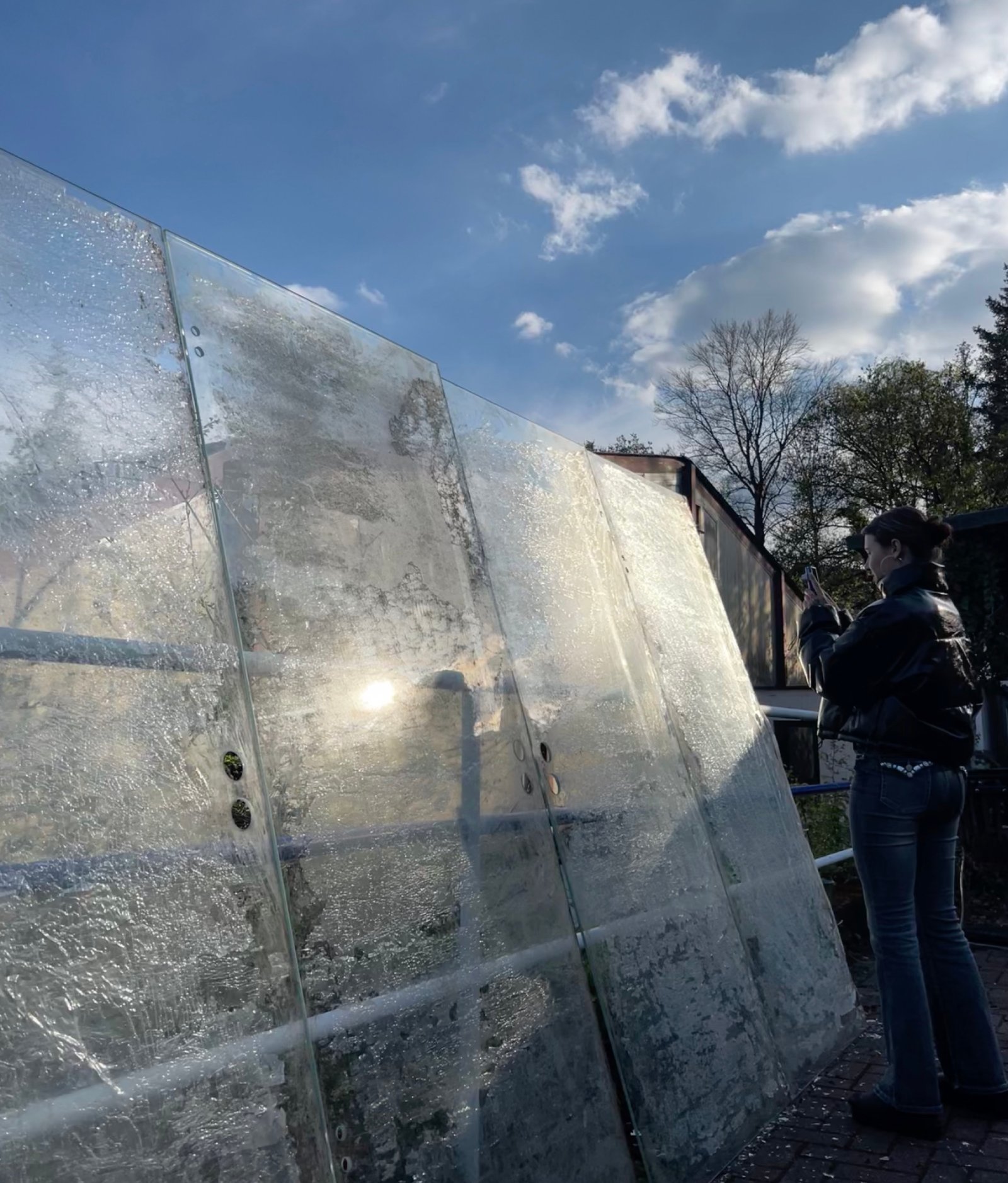
Glass is not a neutral support in Marlon Nikolai’s practice. It operates simultaneously as surface, threshold and optical body: it transmits, reflects, refracts and partially conceals, placing image, light, environment and viewer in a changing relation.
Its transparency is never simply absence. Thickness, inclusions, traces, condensation, scratches and irregularities modulate what can be seen and how it becomes accessible. A view through glass remains bound to the material conditions of the pane; what lies behind it is overlaid by reflections of what lies in front.
In the studio and in spatial installations, glass can separate without fully isolating and connect without dissolving difference. It forms a membrane between interior and exterior, image and surrounding space, proximity and distance. As the viewer moves, reflections shift, backgrounds enter and disappear, and no single stable image remains.
Light activates this material field. It passes through, is redirected at edges and surfaces, breaks into glare or shadow and makes marks visible that would otherwise recede. Glass therefore makes perception itself tangible: seeing becomes an event produced between material, light, position and duration.